What Frontier AI Labs Are Doing About Environmental Impact (And Where They're Falling Short)
The scale of the problem
The companies building foundation models, OpenAI, Anthropic, Google DeepMind, Meta, Microsoft, and the hyperscalers that host them, are adding compute faster than grids and climate targets were planned for. Independent estimates put AI's 2025 carbon footprint at 32.6 to 79.7 million tons of CO₂ and its water use at 312.5 to 764.6 billion liters. By 2030, US AI datacenters alone could add 24 to 44 million tons of CO₂ per year, depending on build-out pace and grid decarbonization.
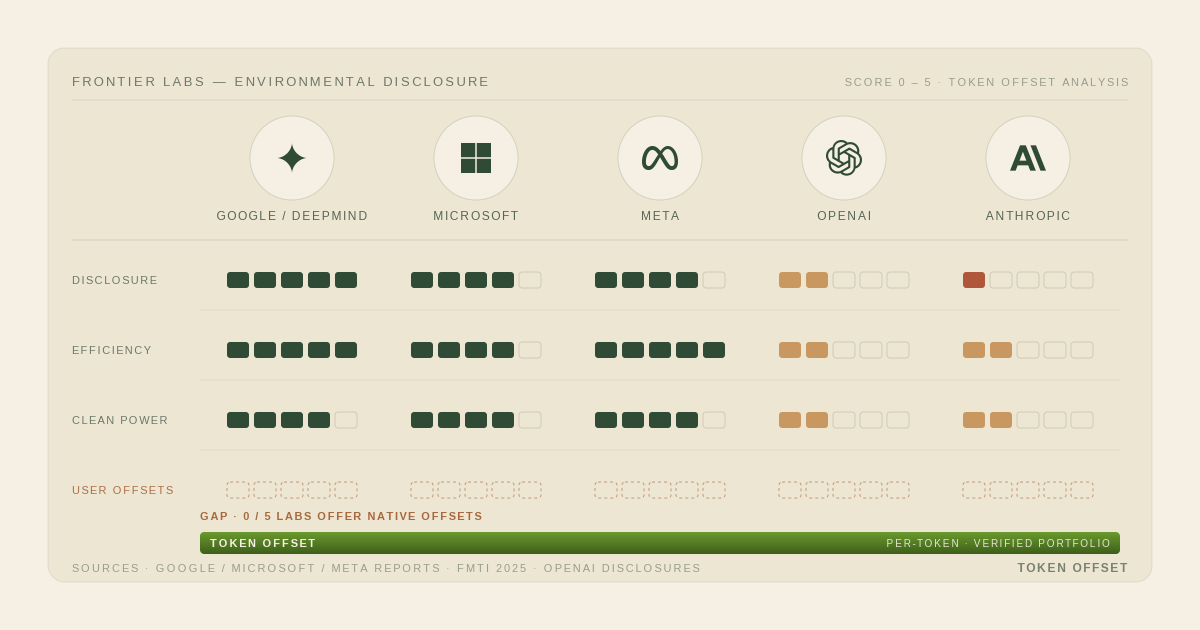
Google, Microsoft, and Meta publish detailed sustainability reports. Mistral and AI2 (OLMo) publish the most detailed model-lifecycle numbers so far. But the standalone labs whose products most of us touch daily, ChatGPT, Claude, Gemini, often disclose the least while scaling the fastest. The Frontier Model Forum coordinates on safety; it has no environmental workstream.
The hyperscaler playbook
Google, Microsoft, Meta, and Amazon run the datacenters where most frontier training and inference happens. Their playbook is familiar: net-zero or carbon-negative targets, 100% renewable matching, water-positive pledges, liquid cooling, custom silicon, and nuclear or geothermal offtake deals.
The wins are real. Google cut datacenter energy emissions 12% while increasing data-center electricity 27%. Microsoft's zero-water AI datacenter design saves more than 125 million liters per facility per year. Meta's PUE of 1.08 is among the best in the industry.
Total emissions at every hyperscaler are still rising, because Scope 3 (hardware manufacturing, construction and the supply chain) grows faster than operational efficiency improves. Per-query gains do not shrink the total when query volume grows faster than the gains.
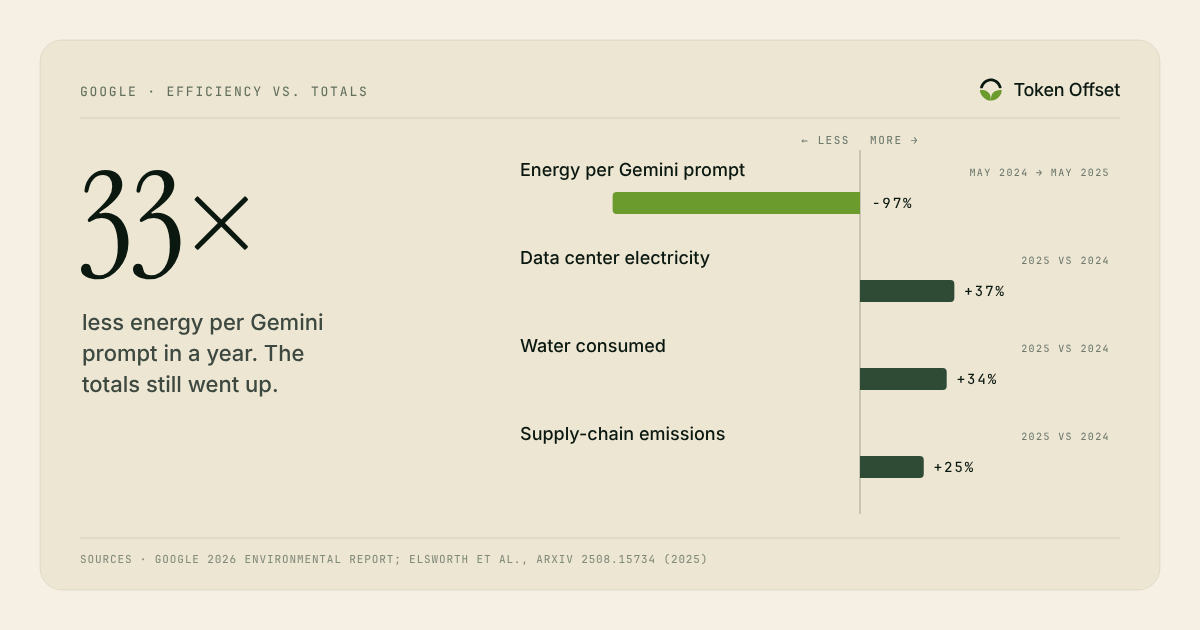
Google's 2026 report is the cleanest example so far. The energy behind a median Gemini text prompt fell 33-fold in a year, yet the company's data-center electricity use grew 37% in 2025, water consumption rose 34% to 10.9 billion gallons, and supply-chain emissions climbed 25%.
Google's per-prompt energy fell while its totals rose
Google, percent change. The per-prompt figure covers May 2024 to May 2025; the totals compare 2025 with 2024.
Energy per Gemini prompt
Down, May 2024 to May 2025
Data-center electricity
Up, 2025
Water consumed
Up, 2025
Supply-chain emissions
Up, 2025
Sources: Google 2026 Environmental Report · Elsworth et al. 2025
View the data
| Measure | Change |
|---|---|
| Energy per median Gemini text prompt | −97% (33× less) |
| Data-center electricity | +37% |
| Water consumed | +34% |
| Supply-chain emissions | +25% |
Standalone labs: policy without receipts
OpenAI and Anthropic do not operate their own datacenter fleets at scale. They depend on Microsoft Azure, AWS, Google Cloud, and partners like xAI's Colossus. That structure makes their environmental footprint largely inherited and easy to hide behind host reporting.
OpenAI's first per-query disclosure (~0.34 Wh per ChatGPT query) was a step forward, but without methodology detail, Scope emissions, or development-stage accounting, it reads more like marketing than audit-ready data. Anthropic's energy report argues for building more power for AI and says little about measuring or reducing its own impact. Neither lab has published standalone environmental reports or Science Based Targets.
Lab by lab: mitigation and gaps
- Most comprehensive disclosure
What they're doing: Publishes annual environmental reports with data-center energy emissions down 12% year-over-year despite a 27% increase in data-center electricity. DeepMind's autonomous cooling controls deliver roughly 30% average cooling energy savings. Google published a production-scale Gemini inference study (0.24 Wh, 0.03 g CO₂e, 0.26 mL water per median text prompt) and signed contracts for over 8 GW of new clean energy in 2024.
Where they could do more: Total company emissions still rose 11% as Scope 3 grew. Market-based accounting can understate grid reality. “AI helps climate” claims face growing scrutiny when infrastructure emissions climb faster than efficiency gains.
- Infrastructure efficiency + Azure host
What they're doing: Carbon negative by 2030, water positive by 2030. Zero-water evaporative cooling on new AI datacenters (Microsoft estimates more than 125 million liters saved per site per year), mass-timber construction, and 34 GW of contracted carbon-free electricity. Hosts much of OpenAI's compute on Azure.
Where they could do more: Total Scope 1+2+3 emissions are up 23.4% versus its 2020 baseline. AI build-out is driving Scope 3 growth faster than operational wins. OpenAI's footprint is largely inherited and obscured inside Azure reporting.
- Efficient datacenters, open weights
What they're doing: Net-zero across the value chain by 2030, water positive by 2030. Operations net-zero since 2020 via 100% renewable matching. Data-center PUE of 1.08 and WUE of 0.19 L/kWh in 2024. Investing in nuclear and geothermal; publishing Llama as open weights may save other teams from repeating the same training runs.
Where they could do more: Shareholder analyses citing Meta's own disclosures put location-based data-center energy emissions up 223% since 2019. Electricity consumption reached 18.4 TWh in 2024. Meta's Llama 3.1 model card discloses 8,930 tCO₂e location-based for 405B training, but market-based figures are reported as zero under renewable matching, which obscures grid reality.
- Per-query disclosure, Stargate build-out
What they're doing: First per-query figures from Sam Altman (~0.34 Wh and ~0.32 mL water per average ChatGPT query). Stargate infrastructure messaging emphasizes closed-loop cooling and water stewardship. Compute capacity grew from 0.2 GW in 2023 to about 1.9 GW in 2025.
Where they could do more: No standalone environmental report, no verified Scope 1/2/3 emissions, no climate targets. At least three Stargate sites are planned with on-site natural gas microgrids. Per-query metrics lack methodology detail and ignore development-stage compute (up to 82% of total GPU energy in recent full-pipeline studies).
- Policy advocacy, massive compute scale
What they're doing: Published a policy-focused energy report advocating nuclear, geothermal, transmission reform, and faster permitting. Secured multi-gigawatt compute partnerships with AWS and Google for Claude training and inference.
Where they could do more: Among the least transparent frontier labs: no environmental report, no Scope 1/2/3 disclosure, no quantitative targets. The 2025 Foundation Model Transparency Index scored Anthropic 0/1 on energy, carbon, and water disclosure. Much of its compute runs on AWS regions backed by a US grid averaging about 384 g CO₂/kWh.
Where the industry could do more
Publish full lifecycle emissions. Training, development, post-training, inference at scale, and hardware embodied carbon, rather than a single benchmark run or a per-query average.
Separate AI from general cloud. Hyperscalers bundle AI compute into datacenter totals. Users cannot tell whether their Claude session or ChatGPT query is covered by a net-zero pledge or a gas microgrid.
Report location-based carbon intensity. Market-based renewable credits do not change the grid your inference runs on tonight.
Offer user-facing offsets at the source. None of the major labs ship a native “offset my usage” toggle. That gap is why Token Offset exists: per-token accounting with a published 90/10 split and public methodology, ready to plug in the moment a lab wants to offer it in-product.
Add an environmental lane to the Frontier Model Forum. Safety coordination exists; sustainability standards do not. The industry needs shared disclosure norms before regulation forces incompatible formats.
What Token Offset adds as a partner
Labs do not need to invent offset infrastructure from scratch. Token Offset already meters token usage, converts it to watt-hours, milliliters of water, and grams of CO₂ using transparent coefficients, and sends 90% of each subscription to a climate partner, with a dashboard that shows users what they paid and what went to the partner.
Integration shapes vary: an in-product toggle at checkout, an OAuth connect flow, org-wide dashboards, or a lab-branded climate fund. The meter is built; the missing piece is a first-party handshake with the labs whose tokens we already measure.
What you can do today
Pair your offset with engineering discipline from our 10 ways to reduce AI's environmental impact post and support the orgs in our best environmental organizations guide.
Work at a frontier lab? Help us plug in.
We are pursuing partnerships with Anthropic, OpenAI, Google DeepMind, Cursor, and the teams that host their compute. If you are on a partnerships, policy, or sustainability team, the fastest path is straight to our inbox.
Email partnerships@tokenoffset.comNot on the inside? Apply pressure anyway.
Share this post, and ask the labs you use, in support threads and product feedback, when they will publish full lifecycle emissions and offer a native offset option. Link to our page for labs.
Frequently asked questions
- Which frontier AI lab has the best environmental disclosure?
- Google and DeepMind publish the most comprehensive environmental reporting, including a production-scale Gemini inference study and datacenter emissions trends. Microsoft and Meta publish strong sustainability reports but bundle AI compute into broader cloud totals. OpenAI and Anthropic remain among the least transparent standalone labs.
- How much carbon do AI datacenters emit?
- Independent estimates put AI's 2025 carbon footprint at roughly 32.6 to 79.7 million tons of CO₂ globally (de Vries-Gao, Patterns 2025), with US AI datacenters alone potentially adding 24 to 44 million tons per year by 2030 (Siddik et al., Nature Sustainability 2025). Labs often report per-query efficiency without total volume, which can understate absolute impact.
- Can users offset AI usage if the labs do not offer it?
- Yes. Token Offset meters token usage, converts it to energy, water, and carbon using public methodology, and sends 90% of each subscription to a climate partner. Labs can integrate in-product via partnerships@tokenoffset.com; users can offset today while pressuring labs to add native paths.
- What should frontier AI labs do next on climate?
- Publish full lifecycle emissions (development, training, post-training, inference, and hardware), separate AI from general cloud reporting, report location-based grid carbon intensity, and offer user-facing offsets at the source. The Frontier Model Forum should add an environmental workstream alongside safety.