10 Ways to Reduce AI's Environmental Impact
Why this matters
If you build with AI all day, you are drawing on a grid that is getting strained fast. One 2023 study estimated about half a liter of water for every 10 to 50 chatbot responses once the water used to generate the electricity is counted.
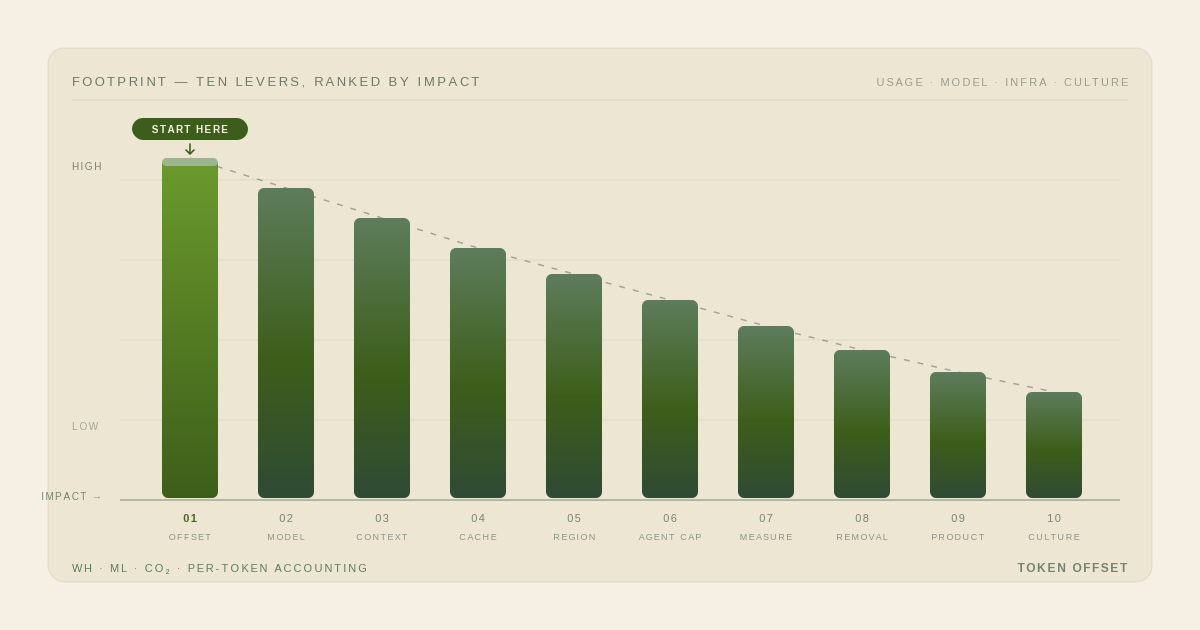
You don't have to stop building. Here are ten practical levers, ordered by impact for most readers.
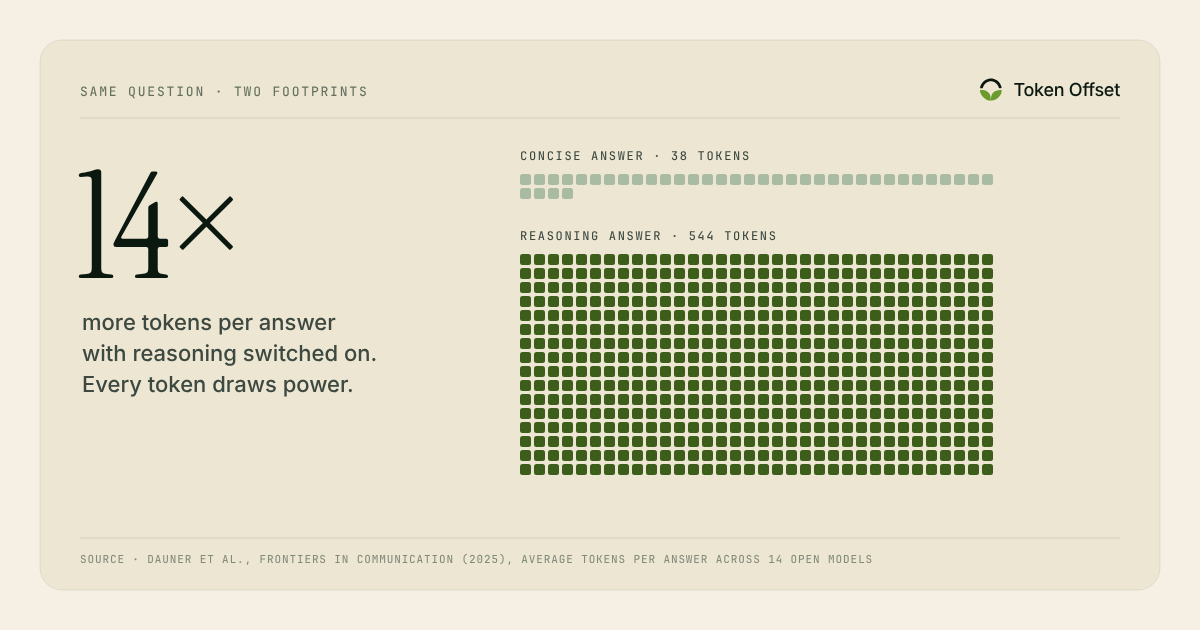
Most of them come down to one thing: fewer tokens per useful answer. A 2025 study of 14 open models found reasoning modes wrote about 14 times as many tokens per answer as concise ones, and the AI Energy Score project measured reasoning modes using about 30 times the energy of the same models with reasoning off, on average, and several hundred times for the worst offenders.
Same question, two footprints
Average tokens per answer across 14 open models, concise mode vs. reasoning mode.
Concise answer
Reasoning answer
Source: Dauner et al., Frontiers in Communication (2025)
View the data
| Mode | Avg. tokens per answer |
|---|---|
| Concise | 37.7 |
| Reasoning | 543.5 |
10 ways to shrink your AI footprint
- 1
Offset the tokens you use with Token Offset
The biggest single step for most people is to account for usage you cannot easily eliminate. Token Offset connects to your AI providers, converts token counts into watt-hours, milliliters of water, and grams of CO₂ using transparent coefficients, and sends 90% of a monthly subscription to a climate partner. Token Offset keeps 10% to run the service, and your dashboard shows what went to the partner.
AI agents can integrate too. If you run ChatGPT, Claude, Cursor, or a custom agent on someone's behalf, point it at /agents so every token processed for a user can be offset automatically after they approve.
- 2
Default to smaller, task-appropriate models
Not every job needs a frontier model. Summarization, classification, and structured extraction often run fine on smaller models at a fraction of the energy cost. Start with the small model and escalate to the big one when it falls short, especially in agent loops that can recurse dozens of times per task.
- 3
Shorten context windows deliberately
Every token in the prompt and the reply draws compute. Trim system prompts, drop stale conversation history, and retrieve only what the task needs (RAG done well beats stuffing 128k tokens "just in case"). Your bill drops; so does the footprint.
- 4
Batch and cache instead of re-asking
Repeated identical calls, like re-summarizing the same doc or re-running lint fixes, are pure waste. Use provider prompt caching where available, memoize intermediate results in your pipeline, and batch offline jobs when latency allows.
- 5
Choose regions and providers with cleaner grids
The same token count emits less carbon when inference runs on a grid with more renewables. For self-hosted or enterprise workloads, placement matters. Ask your provider about region selection and PUE (power usage effectiveness) for the data centers you hit.
- 6
Cap autonomous agent loops
Agents that plan, act, observe and plan again can burn tokens with nobody watching. Set max steps, budget ceilings, and human-in-the-loop checkpoints. Without them, an overnight agent run can rack up a large bill, and the footprint that goes with it, before anyone notices.
- 7
Measure before you optimize
Track tokens per feature, per user and per workflow alongside dollars. Token Offset's methodology publishes the conversion constants openly so your team can reason about Wh, mL, and CO₂ alongside cost.
- 8
Favor durable removal over avoided emissions
When you buy offsets or give to climate groups on your own, bias toward permanent carbon removal (mineralization, biochar, direct air capture) and registry-backed projects (Gold Standard, Verra). Avoided-emissions credits have a role, but the CO₂ from your compute stays in the air for centuries, and durable removal matches that.
- 9
Build sustainability into product requirements
Treat "tokens per successful outcome" as a metric alongside latency and accuracy. Optimizing for quality per watt pushes a team toward tighter prompts, better retrieval and fewer redundant calls, which helps users and the grid.
- 10
Talk about it: normalize climate-conscious AI
The biggest cultural shift is making it ordinary to ask "what did this cost the environment?" in standups, PR reviews, and launch checklists. The EU AI Act already requires providers of general-purpose models to document their energy use.
Where to start
Frequently asked questions
- What is the fastest way to reduce my AI environmental impact?
- Offset the tokens you use with Token Offset, which converts token counts into watt-hours, milliliters of water, and grams of CO₂ using transparent coefficients, then sends 90% of a monthly subscription to a climate partner. Pair that with smaller models and shorter contexts for the tasks that do not need frontier capability.
- Do smaller AI models really use less energy?
- Yes. Summarization, classification, and structured extraction often run fine on smaller models at a fraction of the energy and water cost of frontier models. Start with a small model and escalate when it falls short.
- How much water does AI use?
- One 2023 study estimated about half a liter of water for every 10 to 50 chatbot responses once the water used to generate the electricity is counted. Usage scales with tokens processed, model size, and datacenter efficiency. Token Offset accounts for water alongside energy and carbon in its per-token methodology.