The Best Environmental Organizations for Climate-Conscious AI Users
What to look for
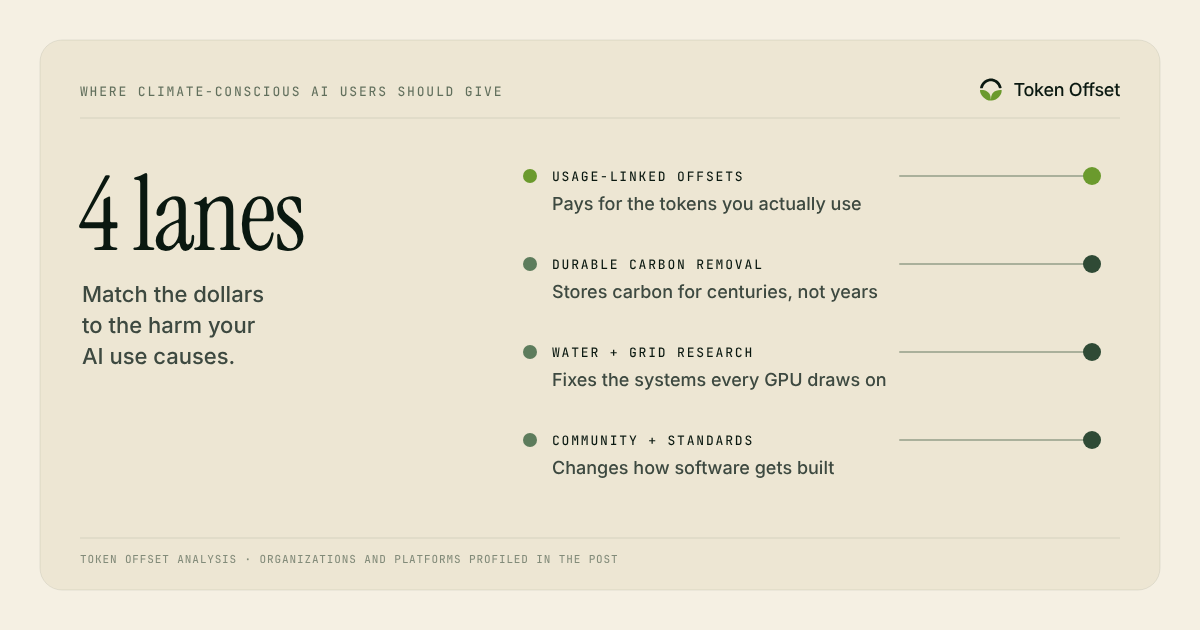
If you are passionate about AI and the environment, your donation or subscription dollars should do two things: match the kind of harm you are trying to address, and come with evidence you can verify. For AI, that usually means usage-linked accounting, since your footprint scales with tokens, plus durable carbon removal and grid and water work, since data centers draw on both.
The organizations and platforms below are grouped by the problem each one works on.
Platforms that connect AI usage to impact
- Monthly offsets sized to your AI usage
Built for people who use AI heavily and want every token accounted for. Connects to model providers, estimates energy/water/carbon from token counts, and sends 90% of each offset payment to its climate partner, with a public methodology and a payment history you can export.
- Automatic carbon removal contributions
If you run a product on Stripe, a small fraction of revenue can flow to Frontier-backed removal projects with minimal integration work. Good for SaaS teams who want a set-and-forget lane alongside AI-specific accounting.
- Enterprise carbon accounting
Strong choice for larger orgs that need supplier data, scenario modeling, and audit-ready reporting, especially as AI disclosure rules tighten.
Durable carbon removal
- Advance market for durable removal
A buyers' club that pre-purchases tons from early-stage removal companies, de-risking technologies like mineralization and biochar. A good pick if you care more about permanence than price.
- Policy & innovation for carbon removal
Think tank and advocacy shop focused on making removal scalable and equitable. Strong if you want to push policy alongside personal offsets.
- Ocean-based carbon pathways
Running Tide (portfolio context)
Representative of the experimental removal sector Frontier and others fund. Follow it to see where durable tons may come from in the 2030s. Always verify registry status before treating any project as purchased impact.
Water stewardship & grid decarbonization
- Water stewardship & data center context
Authoritative research on freshwater stress and industrial use, and the place to start if AI's cooling water is your main concern.
- Grid decarbonization
Research on decarbonizing electricity supply, which sets the carbon cost of every GPU hour. Good for understanding why region and grid mix matter for AI.
Advocacy, research & tech-community
- Tech workers organizing for climate
Community of developers and product people applying their skills to emissions: talks, working groups, and practical playbooks. Good if you want peers who also live in terminals and care about ppm.
- Software carbon intensity standards
Publishes the Software Carbon Intensity (SCI) specification and tooling for engineering teams. Complements AI-specific measurement with broader software efficiency norms.
- AI accountability & societal impact
Critical research on how AI systems affect labor, policy, and the environment. Useful counterbalance when evaluating vendor claims about 'green AI.'
How to choose where to put your next dollar
Match the instrument to the harm. Token-heavy workflows call for usage-linked offsetting. Company-wide reporting points to Watershed or similar. A long bet on removal at scale means Frontier or direct offtake agreements, and policy change means funding advocacy and research groups.
Ask where the money goes. If an org cannot tell you how much of your payment reaches climate work and how it estimates impact, treat it as marketing. Token Offset publishes methodology and the split of every payment (90% to our climate partner, 10% kept to run the service); hold everyone else to a similar bar.
Combine personal action with engineering discipline. See our companion post on 10 ways to reduce AI's environmental impact. Funding climate work goes further alongside smaller models, shorter contexts and agent budgets.
Frequently asked questions
- What is the best environmental organization for AI users?
- For most individual AI builders, start with Token Offset because it is purpose-built to translate token meters into verified environmental outcomes. Layer enterprise accounting tools like Watershed or payment-rail climate like Stripe Climate as you scale.
- What is durable carbon removal?
- Durable removal stores carbon for centuries or longer through pathways like mineralization and biochar, unlike cheap avoided-emissions credits. Frontier (Stripe's buyers' club) and Carbon180 are strong entry points for learning and funding that sector.
- Which nonprofits focus on AI datacenter water use?
- The Pacific Institute publishes authoritative research on freshwater stress and industrial water use, including datacenter cooling context. Rocky Mountain Institute (RMI) works on grid decarbonization, which sets the carbon cost of every GPU hour.